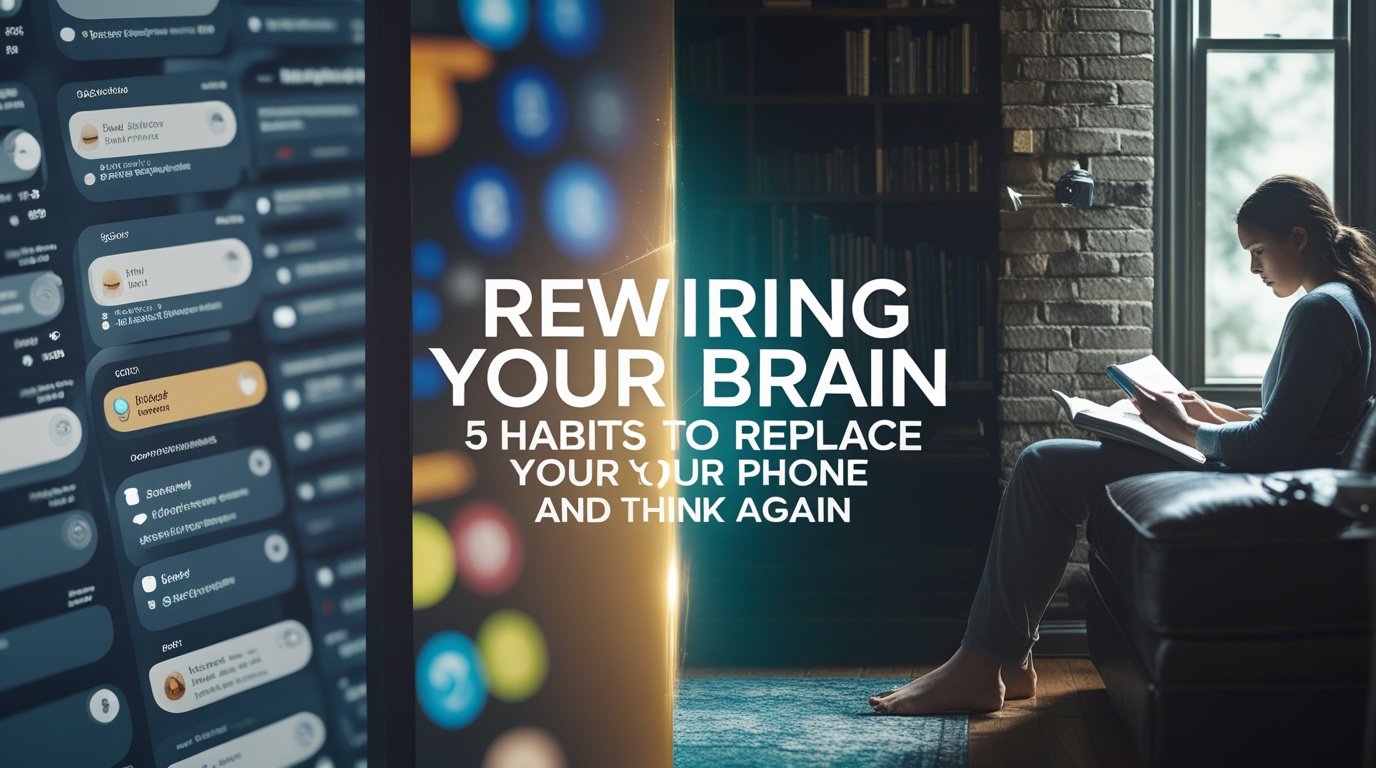
Rewiring Your Brain | 5 Habits to Replace Your Phone and Think Again:

In the first part of this series, we looked at the alarming neuroscience behind our digital habits. We discovered how endless scrolling forces our nervous system into a survival freeze state, lowers our natural dopamine baseline, and shuts down the Default Mode Network the very region of the brain responsible for original, creative thought.
Understanding the science is crucial, but it is only half the battle. Knowing why your brain feels broken does not automatically fix it. The real challenge begins when you put down your smartphone and look around your room, only to realize that the silence feels incredibly uncomfortable.
Your hand instinctively twitches, searching for the smooth glass of your screen. Your brain, desperate for its usual high-dopamine stimulation, begins to panic.
To break this addiction, you cannot simply rely on willpower. You need a practical, step-by-step strategy to teach your nervous system that being unstimulated is completely safe. Here are five low-stakes, highly effective habits designed to reduce the magnetism of your smartphone, break the cycle of mental fatigue, and wake your mind up to the physical world.
Habit 1 – The Art of Reading Out Loud:
When you attempt to read a physical book after years of heavy social media consumption, you will notice a frustrating pattern. Your eyes will move across the page, but your brain will not register a single word. You will finish an entire chapter only to realize you were thinking about something else the whole time.
This happens because your brain has been conditioned to skim text the same way you read comments on video feeds. Your eyes dart rapidly across the surface, looking for quick, catchy pieces of information without fully absorbing the context.
To break this habit and rebuild your attention span, you must actively slow down your reading speed. The most effective way to do this is by reading out loud.
When you speak the words and hear your own voice, your brain processes the language through multiple sensory channels. It forces you to engage with the rhythm, structure, and true meaning of every single sentence.
If reading out loud feels too exhausting, a great alternative strategy is to listen to a professional audiobook while reading the exact same physical text at the same time. This double layer of sensory input keeps your mind grounded in the present moment, making it incredibly difficult for your attention to drift away.
Habit 2 – Keep Low-Stakes Objects in Your Hands:
A massive reason why we struggle to put down our smartphones has nothing to do with the actual content inside the apps. It is a purely physical habit. Over several years, your arm muscles and fingers have developed strong muscle memory associated with holding, tapping, and flipping a phone every three minutes.
When you suddenly try to sit down without your device, your hands feel empty and restless. Instead of fighting this physical urge through intense restriction, you should simply replace the phone with a completely harmless, low-stakes alternative.
Keep a physical notebook open on your desk at all times. If a sudden thought pops into your head, or if you feel a wave of restlessness, grab a pen and doodle or write your thoughts down by hand instead of reaching for a screen.
You can also place tactile items on your desk, such as a Rubik’s cube, a set of traditional worry beads, a basic fidget toy, or even a simple lip balm cap to play with. By giving your hands something physical and engaging to touch, you satisfy the physical motion of fidgeting while keeping your brain entirely free from digital inputs.
Habit 3 – Walk Without Technology:
Modern culture has turned many of us into intense productivity perfectionists. We feel a constant pressure to optimize every single minute of our day. We cannot simply walk to the grocery store or clean the house anymore; we feel forced to “habit stack” by listening to educational podcasts or audiobooks at double speed.
While learning is wonderful, filling every quiet moment with informative audio keeps your Default Mode Network completely offline. Your brain never gets a single second to process its own thoughts, leading to high levels of internal anxiety.
To counter this, start taking short walks with absolutely nothing in your ears. Leave your headphones at home and look at the environment around you.
If a solitary walk feels too intimidating at first, look for physical activities that naturally forbid technology. Practicing yoga in an outdoor park, running, or attending a local fitness studio are fantastic options.
When you surround yourself with people who are all working toward the same physical goal without screens, you get to experience 60 to 90 minutes of pure, uninterrupted disconnection from the digital world.
Habit 4 – Protect One Slow Thing Every Day:
You do not need to delete all your social media accounts or completely abandon modern technology to heal your nervous system. An all-or-nothing approach usually leads to immediate failure. Instead, choose just one slow activity every single day and fiercely protect it from your phone.
This habit can start with something incredibly simple, like committing to drinking your morning tea or coffee for five minutes without looking at a screen. Look out the window, focus on the warmth of the mug, and let your mind wander completely.
Once you master this, apply the same rule to other daily routines. If you used to listen to a loud podcast while taking a shower or cooking dinner, try doing those activities in complete silence.
By systematically removing your phone from these small moments, you teach your nervous system a crucial lesson: being unstimulated is not dangerous. It might feel strange or boring at first, but this intentional boredom is precisely where your mind finds the freedom to create beautiful, original thoughts.
Habit 5 – Replace Your Phone with Single-Use Objects:
Smartphones are incredibly difficult to put down because they are designed to do absolutely everything. Your phone is your morning alarm clock, your camera, your personal journal, your maps, your calculator, and your calendar.
While having all these utilities in a single device is highly convenient, it creates a dangerous psychological trap. You pick up your phone with the honest intention of setting a morning alarm, but the second your screen lights up, you see a notification, click it, and spend the next hour scrolling through an algorithm.
To destroy this magnetic pull, you must systematically reintroduce single-use physical objects into your living space:
- Buy a physical, retro alarm clock and place it right next to your bed. This completely removes your excuse for keeping your smartphone on your nightstand while you sleep. You can comfortably leave your phone in another room overnight.
- Purchase a high-quality paper journal and write your daily reflections by hand with a real pen instead of using a digital note app.
- Use a physical wrist watch to check the time and keep a standard calculator on your office desk.
The more single-use objects you add back into your daily environment, the fewer reasons you will have to touch your phone, causing the addictive habit of constant reaching to naturally wither away.
Conclusion:
When you consistently implement these five habits and successfully pull back from high-dopamine digital consumption, an extraordinary transformation occurs. You obviously get your attention span back, your patience increases, and you become far more present in your personal conversations. But the most beautiful reward is a phenomenon called sensory awakening.
When you stop staring at a digital screen, your brain suddenly rediscovers the rich, physical environment around you. You will pass by flowers in your house and experience a strong urge to smell them. You will notice the intricate texture of a stone wall, the changing patterns of the afternoon sky, or the vivid colors of the trees outside.
Because scrolling keeps your hands busy and your mind overwhelmed, your physical senses go completely dormant. The moment you lay your phone down, your hands go looking for things to feel, and your mind finally wakes up. You stop observing life through a glass screen and start living it completely.
FAQs:
1. Why does reading out loud help me focus better than reading silently? Years of scrolling condition your brain to rapidly skim text on a surface level. Reading out loud forces you to slow down, engages your vocal and auditory senses simultaneously, and compels your brain to deeply process the meaning of every sentence.
2. How can keeping a simple object like a Rubik’s cube on my desk prevent me from scrolling? A large part of phone addiction is purely physical muscle memory. By replacing your smartphone with a low-stakes, tactile object, you satisfy your hand’s natural urge to fidget without introducing addictive digital stimulation to your brain.
3. Is it bad to listen to educational podcasts while walking or doing chores? It is not inherently bad, but doing it constantly prevents your brain from resting. Your Default Mode Network requires complete freedom from external input to process memories and generate original thoughts. Leaving your headphones behind gives your brain the necessary space to think.
4. What is the benefit of using an old-fashioned physical alarm clock instead of a phone? Using a phone as an alarm creates a trap where you immediately check notifications or browse apps the moment you wake up or go to sleep. A physical alarm clock allows you to banish your phone from the bedroom entirely, protecting your sleep quality.
5. What exactly is “sensory awakening” after a digital reset? When your mind is constantly overloaded with digital notifications, your real-world senses go dormant. Once you reduce screen time, your brain has the spare energy to notice your physical surroundings, making sounds, smells, and physical textures feel significantly more vibrant.