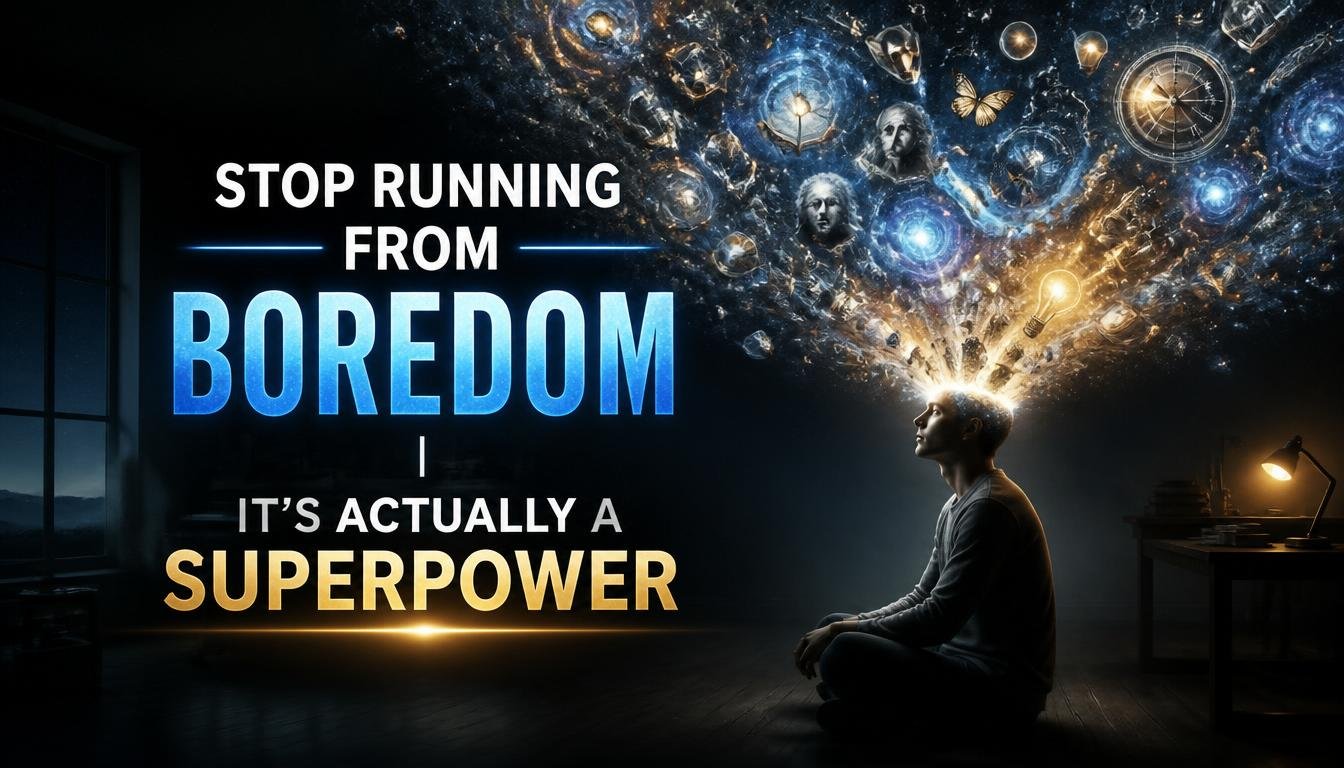
Stop Running from Boredom | It’s Actually a Superpower:

Let’s get real for a second: sitting in a quiet room with absolutely nothing to do feels… well, awful. Most of us would rather scroll through mind-numbing videos for three hours than sit with our own thoughts for ten minutes. We’ve been brainwashed to think that being “busy” is a personality trait and that boredom is a total waste of time.
But I’m starting to think we’ve got it backwards.
Boredom isn’t some empty void you need to escape. It’s actually a massive opportunity. It’s the only time your brain isn’t being fed “content” and actually has to produce its own thoughts. That awkward, itchy feeling of having nothing to do? That’s where the growth happens. It’s how you actually start to understand what’s going on in your own head instead of just reacting to the world around you.
The Problem With How We Talk About “Mindfulness”:
“Mindfulness” has become such a buzzword that it’s almost lost its meaning. It’s on every podcast and in every “productivity” app, but let’s strip away the marketing for a minute.
Real mindfulness isn’t about some fancy breathing technique or sitting in a perfect lotus position. It’s much simpler—and a lot harder. It’s what happens when you finally stop the noise. No phone. No music. No “to-do” lists. Just you.
In that moment, you aren’t trying to achieve anything. You aren’t “fixing” your stress or chasing some zen-like state of happiness. You’re just… existing. You’re watching your thoughts pass by like cars on a highway without feeling the need to jump into traffic.
Everyone is looking for peace in a new book or a better routine. But the clarity we’re all starving for? You can’t buy it or download it. It only shows up when you’re brave enough to just be bored for a while.
Actually, Having a “Boring” Life is a Total Power Move:
Let’s be real. Society loves to talk trash about a quiet life. If you aren’t out every night, hopping on planes, or posting some high-energy highlight reel, people assume you’re just… stuck. They think “boring” means your life has no soul.
But they’re dead wrong.
Honestly, living what people call a “boring” life is probably the biggest advantage you can have. Think about it. When you aren’t constantly chasing that next hit of dopamine or looking for external noise, you finally get some actual breathing room. While everyone else is burning out trying to stay “excited,” you’re actually getting to know yourself. Being boring just means you aren’t distracted. You aren’t running away from the person in the mirror. And in a world that’s losing its mind, that’s a massive win.
Why You Need to Stop Killing Your Boredom:
We treat boredom like a disease. The second there’s a gap in the day, we reach for our phones to kill it with garbage content or endless scrolling. But here’s the thing: boredom isn’t a waste of time. It’s a gateway.
When that itchy, “I’m bored” feeling hits, it’s just an invitation. It’s your brain finally shutting out the world so it can turn inward.
This is where the real magic happens. When you stop feeding your brain constant junk, you start noticing things. You question your habits. You rethink your goals. But even better? This is exactly where creativity hides. When you stop the input, your brain is forced to start creating its own “output.” Every big idea, every weirdly genius invention, and every “eureka” moment usually comes from that quiet, slightly annoying space where nothing else is happening. Boredom isn’t empty. It’s just waiting for you to do something with it.
Quit Being a Puppet to Your Own Life:
Look, let’s be real for a second. Most of us are just… floating. We spend every single day just reacting. A phone pings? We look at it. Is someone a jerk? We snap back. It’s like we’re stuck on this weird, mindless autopilot, just bouncing off whatever crap the world throws our way. We aren’t really “living” our lives; we’re just responding to the noise.
But here’s the kicker. When you actually force yourself to sit in a quiet room, no phone, no music, nothing, the whole game flips. You start seeing the gears turning in your own head. You stop being a puppet to every random mood or annoying email.
And no, this isn’t some “self-help” fluff. It’s about clarity. You finally start to see the why behind your own mess. Why am I actually frustrated? Why do I keep making these same dumb calls? It’s not about hiding from life. It’s about finally being awake while you’re actually in it. It’s about grabbing the steering wheel instead of letting the world drive you into a ditch.
Why Being “Bored” is Actually a Flex:
This might sound a bit “out there,” but if you’re someone who gets bored easily, it might mean you’re sharper than the average person.
Seriously. Some people are totally fine cruising through the same mindless routines and shallow small talk forever. They’re comfortable. They never ask “why?” But if you’re sitting there feeling restless and annoyed by the “normal” stuff, it’s usually because your brain is starving for something real.
You aren’t satisfied with surface-level junk. Your mind is digging for something deeper—trying to figure out how people tick, why society is so messy, or what actually matters. That boredom? It isn’t a defect. It’s a signal. It’s your brain saying it’s ready to ditch the obvious and find some actual insight. You don’t lack interest. You have a much higher bar for what’s actually worth your time.
Stop Fighting Boredom at Your Desk:
Look, we’ve all been there. You’re staring at a textbook or a screen and your brain just… shuts off. Most people think that “studying boredom” is just a sign that they’re lazy or not cut out for the work. But honestly? That’s total nonsense.
Boredom isn’t a wall; it’s more like a tap on the shoulder. Instead of just grinding your teeth and forcing yourself to keep going like some mindless machine, take a second. Ask yourself why it feels so soul-crushing. Is it the way you’re learning? Is the topic just not clicking?
When you stop and actually listen to that boredom, you start finding better ways to get the job done. It’s the difference between just memorizing facts to pass a test and actually getting it. Use that “meh” feeling as a tool. It’ll make your work a whole lot more effective, trust me.
The Big Takeaway:
If you get anything from this, let it be this: boredom isn’t the enemy. It’s a signal. It’s your brain’s way of saying, “Hey, look inward for a minute.”
We’ve learned that mindfulness isn’t some fancy thing you have to go out and buy. It just happens when you stop running and actually show up for your own life. And that “boring” life everyone’s so scared of? It might actually be where the real depth is. Stress, stillness, boredom, none of this stuff is random. It’s all just gear you can use to grow, as long as you stop reacting like a puppet and start living with your eyes open.
Wrapping It Up:
Yeah, sitting with yourself in a world that won’t shut up is uncomfortable. It feels weird. But that discomfort? That’s where the good stuff is hiding.
Boredom isn’t just an empty hole you need to plug with social media. It’s a space. And inside that space is where your creativity and your actual self are hanging out. When you stop running from the quiet and start listening to it, everything changes. You stop chasing every shiny distraction and start actually digging the stillness. And that’s where you finally find the person you were meant to be.
FAQs:
What is the real meaning of mindfulness according to this perspective?
Mindfulness is not about following a specific practice or trend. It is about being present with yourself without distractions. It naturally happens when you sit alone and observe your thoughts without reacting to them.
Why is boredom considered useful in this discussion?
Boredom is seen as a gateway to self-discovery. It creates space for reflection, creativity, and deeper thinking, allowing you to understand yourself better.
How can boredom improve creativity?
When your mind is not overloaded with external input, it starts generating its own ideas. This leads to imagination, innovation, and new ways of thinking.
Is living a “boring” life actually beneficial?
Yes, according to the script, a “boring” life in the eyes of others can provide more opportunities for self-reflection, growth, and understanding.
How can students use boredom positively in their studies?
Instead of seeing boredom as a problem, students can use it to reflect on their learning methods and find deeper ways to engage with their subjects, leading to better understanding.